Crypto Regulatory Reset 2026: Compliance, Privacy & ETFs
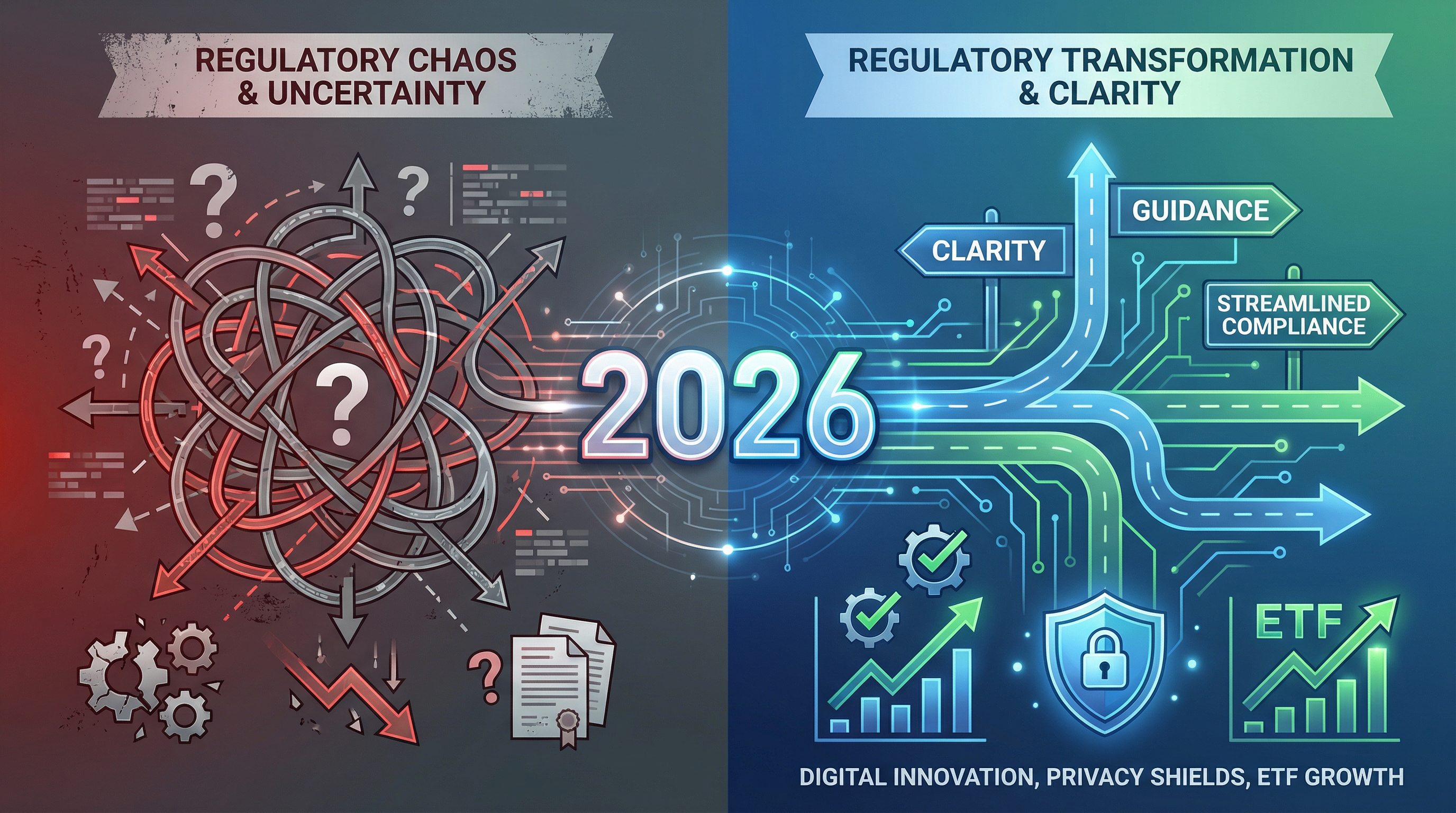
The year 2026 brings a mix of regulatory clarity and political friction in the crypto sector. Key trends include the institutional adoption of crypto via regulated products like ETFs, the necessity for compliance-friendly privacy tools, and ongoing legislative struggles over market structure and digital identity. Businesses must integrate compliance into product design to meet global standards.
The Regulatory Reset of 2026: Clarity, Privacy, and Political Friction
Introduction
The new year opens with a mix of regulatory clarity and lingering political friction. We are seeing the convergence of several major trends: the institutional adoption of crypto through regulated products, the push for compliance-friendly privacy tools, and ongoing legislative battles over market structure and digital identity.
For businesses operating in this sector, 2026 is shaping up to be a critical year for execution. Regulatory tailwinds are boosting certain product types, particularly exchange-traded funds (ETFs), while compliance demands are forcing innovation in areas like privacy technology. The focus remains on building infrastructure that meets global standards for consumer protection and financial integrity.
Compliance teams need to move beyond reacting to enforcement actions and focus on anticipating legislative shifts. The goal is clear: integrate compliance into product design, not bolt it on later.
Institutionalization and Market Structure
The regulatory environment continues to favor the institutionalization of digital assets. This trend provides much-needed clarity for major financial players but also increases the scrutiny placed on market intermediaries.
The ETF Effect
Crypto ETFs are heading into 2026 with significant regulatory support. This momentum suggests that global regulatory bodies are increasingly comfortable with the mechanics of packaging digital assets into traditional financial products.
Issuers are bracing for a crowded year. The approval of these products signals a maturing market where investor protection can be achieved through established securities frameworks. This acceptance lowers the barrier for traditional capital to enter the sector.
For compliance officers, this means increased focus on custody arrangements, valuation methodologies, and market surveillance. The regulatory burden shifts from defining the asset to ensuring the integrity of the product wrapper.
Legislative Push for Clarity
US lawmakers are expected to address market structure markup early in January 2026. This legislative action aims to define which assets fall under the jurisdiction of the Commodity Futures Trading Commission (CFTC) and which belong to the Securities and Exchange Commission (SEC).
A clear market structure bill would resolve years of regulatory uncertainty. Businesses could finally design their operations, disclosures, and registrations based on defined rules, rather than relying on enforcement actions for guidance. This is the "good regulation" the industry has long sought.
The delay in passing comprehensive legislation, however, continues to create risk. Until the rules are finalized, firms must maintain flexibility and prepare for potential dual registration requirements or shifting definitions of digital asset securities.
CFTC Leadership Signals
The return of Amir Zaidi as the CFTC Chief of Staff is a notable development. Mr. Zaidi was instrumental in enabling Bitcoin futures trading previously.
This appointment signals a strengthening of crypto oversight within the agency, especially as they prepare for new digital asset laws. The CFTC is positioning itself to be a primary regulator for the commodity side of the digital asset market.
Businesses dealing in derivatives or spot commodities should view this as confirmation that the CFTC will be an active and sophisticated regulator. Engagement and proactive communication with the Commission will be essential for firms operating in this jurisdiction.
Privacy, Identity, and Political Concerns
The tension between financial privacy and regulatory mandates like Anti-Money Laundering (AML) continues to drive innovation. At the same time, political debates over government surveillance are heating up.
Compliance-Friendly Privacy Tools
Crypto privacy is reaching an inflection point. Developers are pivoting toward designs that ensure user privacy while simultaneously allowing for regulatory compliance.
This involves building tools where data can be selectively disclosed or verified without revealing the underlying transaction details to the public chain. Zero-Knowledge proofs and similar technologies are moving from theoretical concepts to practical compliance solutions.
The shift is necessary because regulators globally have signaled that completely opaque transaction mechanisms pose too high a risk for illicit finance. For decentralized application (dApp) developers, the practical step is integrating verifiable credentials and selective disclosure mechanisms into their protocols from the start.
The Surveillance State Debate
The debate surrounding Central Bank Digital Currencies (CBDCs) and digital identity is becoming highly politicized. US Representative Warren Davidson raised concerns that digital ID and CBDCs risk turning the US into a "surveillance state."
The core concern is that centralized digital infrastructure, even if designed for efficiency, could strip citizens of financial freedom and privacy if misused. This highlights the inherent trade-off between centralized control and individual liberty—a foundational concept for many in the decentralized finance (DeFi) movement.
While the US is far from implementing a retail CBDC, businesses should track this debate closely. The outcome will influence the regulatory approach to stablecoins and private digital identity solutions, impacting everything from KYC processes to payment rails.
Global Stablecoin Focus
Internationally, Japan and South Korea are leading Asia’s local stablecoin push. This regional focus on regulated, domestic stablecoins indicates a move toward integrating digital currencies into local economies under strict national oversight.
These initiatives prioritize financial stability and monetary sovereignty. They provide a model for how countries can embrace the efficiency of digital payments while maintaining control over currency issuance and capital flows.
Businesses looking to operate across Asia must anticipate fragmented stablecoin regulation. Compliance will require adherence to specific national licensing regimes, reserve requirements, and data localization rules, rather than relying on a single global standard.
Legal Precedents and Consumer Protection
Court rulings continue to shape the boundaries of liability for promoters and platforms in the digital asset sector. These cases provide crucial, albeit slow, guidance on consumer protection expectations.
Voyager Lawsuit Dismissal
A significant development was the dismissal of the class-action lawsuit against Mark Cuban and others concerning the promotion of Voyager Digital. The suit alleged "false representations and other deceptive conduct" following Voyager's bankruptcy.
The dismissal is a win for promoters and endorsers, suggesting that liability for platform failures may not automatically extend to public figures who recommend a service. This ruling adds nuance to the legal standard for endorsement liability in the crypto context.
However, this does not eliminate responsibility. Firms must still ensure that all marketing materials are truthful, non-misleading, and clearly disclose risks. The legal environment remains focused on protecting consumers from outright fraud and material misrepresentations.
Defining Liability
This case, combined with other recent rulings, reinforces the need for clear separation between promotional activities and fiduciary duties. When a platform collapses, courts are looking closely at the specific nature of the relationship between the promoter, the platform, and the end user.
For compliance teams, the takeaway is to audit all marketing partnerships and public statements. Ensure that disclaimers are prominent and that the nature of the relationship (e.g., paid endorsement vs. investment advice) is unambiguous. Ambiguity creates regulatory risk.
Key Takeaways
- Audit Marketing Practices: Review all endorsement agreements and public statements immediately following the Voyager dismissal precedent. Ensure clear risk disclosures and avoid implying fiduciary relationships.
- Prepare for Market Structure: Anticipate legislative action in January 2026 defining CFTC/SEC jurisdiction. Model compliance scenarios for both commodity and security classification for your primary assets.
- Integrate Privacy Solutions: Begin evaluating and integrating compliance-friendly privacy tools (e.g., ZK-proofs for identity verification) into product roadmaps to meet future AML/KYC demands without sacrificing core privacy principles.
- Monitor CFTC Engagement: Given the leadership changes, prepare for increased technical engagement from the CFTC. Proactively document your risk management and surveillance capabilities, especially if dealing in derivatives.
- Segment Stablecoin Strategy: Acknowledge the trend toward localized stablecoin regulation in Asia and elsewhere. Develop separate compliance frameworks tailored to specific national reserve and licensing requirements, rather than seeking a single global approach.
- Focus on Product Integrity: As ETFs proliferate, shift internal compliance focus toward operational integrity—custody, valuation, and redemption processes—as these will be the primary areas of regulatory scrutiny for regulated financial products.
What's Next
The first quarter of 2026 will be dominated by legislative movement in the US. If market structure legislation gains traction, it will provide the clarity necessary to unlock significant institutional investment and operational efficiency. Businesses should dedicate resources to tracking committee markups and preparing for potential new registration requirements.
The convergence of privacy technology and compliance demands is a positive trend. It shows that innovation can solve regulatory problems, rather than simply avoiding them. Firms that invest in these verifiable privacy solutions now will gain a competitive advantage in a world where data protection is paramount.
The practical step is preparation. Do not wait for the final rule; model the impact of proposed rules today. Uncertainty remains high, but the direction of travel—toward clear, regulated access for mainstream finance—is undeniable.
Sources
Cointelegraph The Block
Stay Updated
Get weekly regulatory updates and compliance insights delivered to your inbox.
No spam. Unsubscribe anytime.
Related Articles